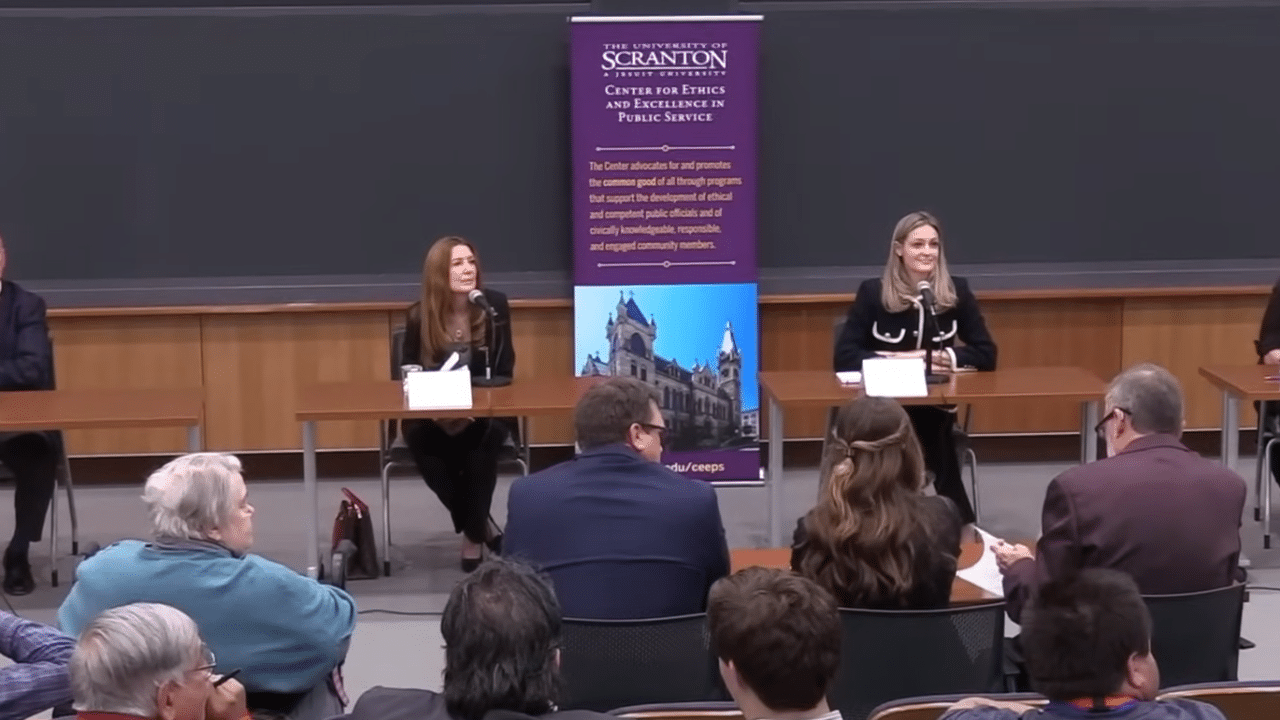
Scranton’s mayoral debate Thursday night wasn’t about big national politics, though a few protesters tried to make it that way. It was about trust — who’s got it, who’s lost it, and who wants another four years to prove it.
The debate, hosted at the University of Scranton, featured Mayor Paige Cognetti, Republican Patricia “Trish” Beynon, and independents Gene Barrett and Rik Little. About 120 people showed up. It was civil enough, aside from the “Free Palestine” interruptions that ended with security escorting a few folks out.
Once the room quieted, the candidates got to what people actually care about: crime, stormwater, and the streets.
Crime and Reality
Barrett and Beynon said what plenty of people feel — that crime is up and downtown doesn’t feel as safe as it used to. Cognetti fired back that the data says otherwise.
“I’m not sure where the people up here with me are getting their crime stats,” she said. “We do not have an increase in crime.”
When pressed, Beynon cited the New York Post. Cognetti shot back, “The New York Post is not a crime database.” She pointed to city dashboards and “proactive policing” as the reason more incidents are being reported.
Barrett wasn’t buying it. “If proactive policing makes crime look higher, then it sounds like we’re admitting there’s more to report,” he said. That’s the kind of back-and-forth that shows how data and perception don’t always match.
Streets, Stormwater, and Priorities
Nobody on stage denied the city’s infrastructure issues. Beynon and Barrett said stormwater management and road repairs should come before “streetscape experiments.” Cognetti defended her record, saying one-third of federal rescue funds have gone to stormwater projects, with more money into paving and new safety designs.
Those projects — the same $27 million downtown streetscape overhaul heading to City Council — aim to replace signals with stop signs, narrow lanes, and add curb bump-outs. Critics call it overreach. Supporters call it progress. Either way, it’s one of the most ambitious traffic changes the city’s seen in decades.
Barrett and Beynon said they’d rather see the money go to drains and pipes that stop flooding. Flash floods still hit Green Ridge, South Side, and Keyser Valley hard. The mayor’s bet is that you can fix the pipes and the pavement. Voters will decide if that’s true.
Sharp Exchanges
Things got personal. Cognetti mentioned Barrett’s ownership of old steam pipes under the city and claimed he hadn’t repaired all of them. Barrett pushed back hard: “Every time we’ve been contacted, it’s been repaired.”
She also brought up his time at the Scranton Sewer Authority, linking him to a lawsuit over landfill leachate — a case that, as it turns out, never named him personally and was dismissed years ago.
Later, Cognetti pointed to audits involving Beynon’s employer and said the city had to recover money. Beynon shot back that the city settled because it was wrong. Even Beynon’s fiancé, sitting in the audience, joined the fray, pointing out that the settlement with his firm cost the city money.
The Double Run
One of the biggest contrasts came on motivation. Barrett and Beynon made a point of saying they’re running for one job only — mayor. Cognetti, who’s also running for Congress against Rep. Rob Bresnahan in 2026, framed it differently:
“If I am elected to Congress in 2026,” she said, “I will make damn sure that in 2027 there is someone sitting here on this debate stage that I can pass the torch to.”
To her opponents, that sounds like planning an exit before the voters have even spoken.
The Bigger Picture
Every debate tells you something beyond the talking points. This one showed where Scranton’s really at. People want basic competence: streets that don’t flood and crosswalks that feel safe.
Cognetti’s betting that steady progress and grant dollars win the day. Barrett and Beynon are betting voters want someone focused only on this job. Little reminded everyone that even the homeless deserve a voice at the table.
What’s clear is that the race has tightened, the tone has sharpened, and for once, a local debate actually felt like it mattered.

Leave a Reply
You must be logged in to post a comment.