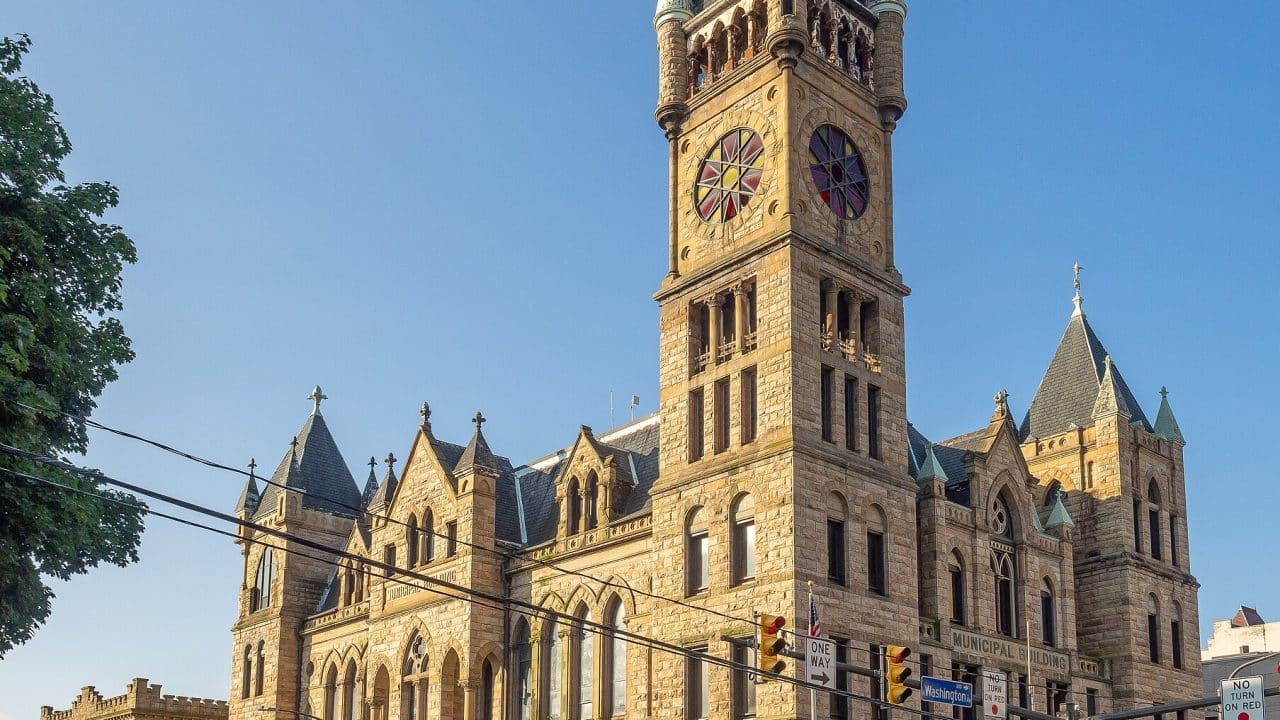
The City of Scranton is still hosting tours to celebrate the freshly restored City Hall as another surprise surfaced: the Cognetti administration wants to buy the Fidelity Bank building next door for $1.88 million and turn it into a municipal annex.
The current lame-duck City Council introduced the legislation on a split 3–2 vote, setting up what is likely to be one of the more contentious capital decisions in recent years. The timing is what has residents talking. After a $4.8 million, 14-month restoration project at City Hall — funded with a mix of state RACP dollars and federal ARPA money — the city is already pivoting toward expanding its physical footprint.
While the administration shows off stained glass restorations, repointed stonework, new slate roofing, refurbished historic rooms, and safe workspaces for the nearly 80 people who staff the building every day, it is simultaneously arguing that City Hall cannot fully meet modern needs.
The newly proposed annex would house permits, licensing, public-facing offices, and a real-time crime center. The administration also points to ADA accessibility challenges at the historic structure — a detail noticeably absent during the 14 months the public was told the restoration was both functional and future-oriented.
Councilmen Mark McAndrew and Tom Schuster were blunt about their hesitation. McAndrew questioned whether the building is a true need or simply a “nice to have,” reminding the administration that responsible governance requires restraint when spending taxpayer money. He said city departments, including the police, can continue to “do a fantastic job” with what they already have, especially considering that the police station itself is relatively new construction.
Schuster went further, comparing the move to the county’s disastrous Globe Store purchase. He noted the risk of buying now and realizing later the city overextended itself. He also raised the question of lost tax revenue — the building currently generates more than $25,000 in annual property taxes — and requested details on assessed value, appraisals, and long-term operating costs.
Business Administrator Eileen Cipriani provided some numbers: both the city and Fidelity had appraisals conducted, with the city’s coming in at $1.75 million and the bank’s at $2.01 million. She argued the building is turnkey, comes fully furnished, and has dramatically cheaper utility costs than City Hall — about $50,000 annually compared to City Hall’s $165,000. She also pointed to a $500,000 grant the city would use to build the real-time crime center.
But none of that answers the core question lingering over the entire debate: if Scranton just poured nearly $5 million into stabilizing, restoring, and modernizing City Hall — and if the administration spent more than a year telling residents the project would create safe, functional, efficient city offices — why is the city now claiming it needs an entirely separate building next door?
The annex proposal reveals an uncomfortable truth: the administration is positioning the Fidelity building as a solution to problems that were never raised during the restoration. Residents were told the City Hall project would solve long-standing issues and provide a solid home for city government. Now they’re being told it cannot handle basic accessibility, public-facing services, and police administration.
Cognetti’s team frames this as a rare opportunity that “would not come again.” Opponents see it as the start of a bigger expansion plan the administration never disclosed while City Hall was wrapped in scaffolding.
Before the city spends another $1.88 million, taxpayers deserve clarity. That price tag doesn’t include renovation or design costs. They deserve to know whether City Hall was truly fixed for the future, as they were promised — or whether the future was always going to include another building, another budget hit, and another round of explanations.

Leave a Reply
You must be logged in to post a comment.